Ordinary symbols
Count the same fruit or sweet anywhere on the field.
Bonanza Atlas · Original game
Use artwork, matching count and stake setting together to understand the original game’s information.
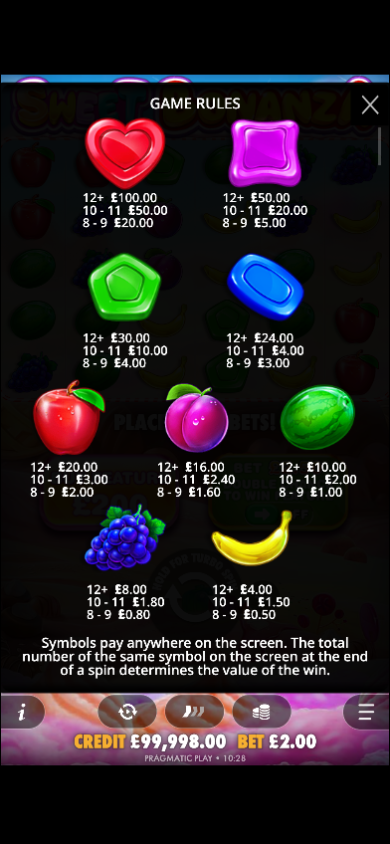
Start by distinguishing ordinary paying symbols from the special Scatter and feature multipliers. The same colourful presentation does not give them the same rule. An ordinary fruit is counted against a paytable band; a Scatter concerns entry to the feature.
Rather than memorising a currency price from an image, learn how to find the relevant row in the current client. Look at the symbol artwork first, then the matching count, then the amount or multiple shown for that row.
Count the same fruit or sweet anywhere on the field.
Read the separate trigger for the ten-spin feature.
Add values at the end of the feature’s tumble sequence.
The original field has six columns and five rows. Matching ordinary symbols can count anywhere in it, so scan all thirty positions. A compact group can be visually prominent while several copies at the opposite edge are easy to miss.
The teaching board uses eight A symbols in separated positions. It describes the spatial rule only. It does not recreate a real round, assign a price to A or imply that a certain arrangement is due next.
A paytable band refers to how many of one symbol have been counted. The stake refers to the amount assigned to starting the round. A larger payment can reflect a different count, a different stake or a feature calculation. Those are separate inputs.
When a table displays amounts in currency, record the current stake beside them. When it displays multiples, keep the unit clear. Do not read the credit balance as if it were the stake, or transfer a practice amount into a claim about a real-money configuration.
Supplier summaries are useful for understanding the overall rule, but the game’s complete information is the reference for the configuration you loaded. Read the exact title too: a paytable from Sweet Bonanza 1000 is not an original-game table.
If you change the stake while browsing, check whether displayed table amounts changed with it. You can do this as a reading exercise without starting more rounds. Close the game once you have identified the symbol, count band and relevant units.
The images below are genuine original-game information views captured on 21 October 2026. The English interface and GBP practice setting remain visible. They show the separate symbol and feature sections in the client that was checked.
Read the original demo’s information for the settings of your current client. No image of a rule panel establishes operator eligibility, a casino promotion or a cash withdrawal.
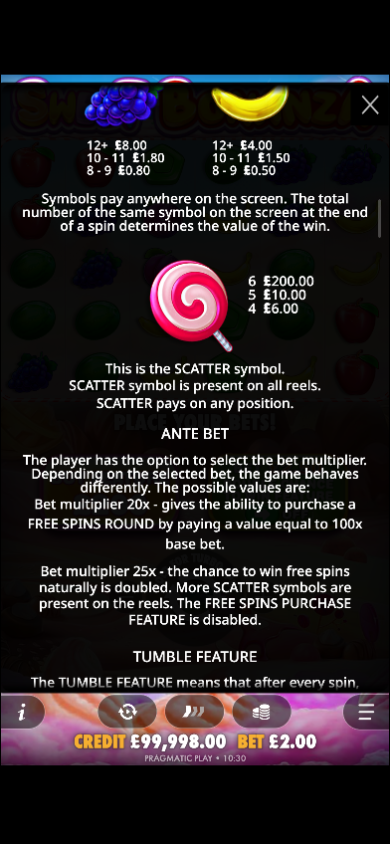
Game identity and feature summary checked 21 October 2026. Current operator settings, access conditions and promotions require their own checks.
The original release’s historical prize-potential wording is not used here as a verified current maximum. No universal RTP, stake range or casino bonus is asserted.